Director Entebbe Regional Referral Hospital Visits UVRI
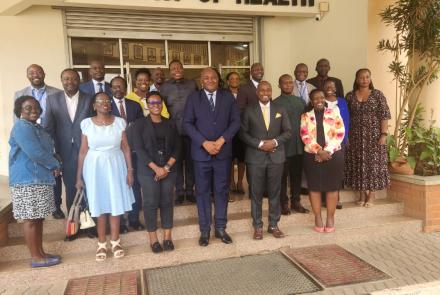
The Director Entebbe Regional Referral Hospital, Dr. Peterson Kyebambe was recently hosted at the Uganda Virus Research Institute. He hailed the long-standing partnership between the hospital and the Uganda Virus Research Institute (UVRI). He was paying a courtesy visit to Professor Pontiano Kaleebu, the Director of UVRI, on Tuesday 7th June 2022. This was Dr. Kyebambe’s first visit to UVRI since assuming office in February 2022.
The two health institutions, established in 1904 and 1936 respectively, have enjoyed a history of collaboration over the years, jointly working on immunization programs and campaigns, pandemics such as HIV/AIDs and Covid-19 as well as infectious and non-communicable diseases. Outcomes of the collaboration have been among others, joint service provision, infrastructural development, and staff capacity development at the hospital on the one hand and provision of opportunities for UVRI and partners to conduct research that has been instrumental in informing national health policies and service provision.
Dr. Kyebambe and Prof. Kaleebu discussed opportunities for strengthening and furthering their collaboration. Specifically, UVRI will support the hospital to establish an Institutional Review Board for research approvals. In the meantime, UVRI Institutional Review Board (IRB) will review concepts and research protocols from the hospital. The institutions will also strengthen their collaboration for the ongoing research – Clinical Characterization of COVID-19 Protocol (CCP) funded by European and Developing Countries Clinical Trials Partnership (EDCTP).
The hospital generates a lot of data useful for research and publications, while UVRI has the capacity for data analysis. This creates opportunities for staff of the institutions to co-author scientific research articles and provide training to build laboratory staff capacity for improved diagnostics. The two could also jointly apply for grants to procure specialized equipment to support research and diagnostics for management of diseases at the hospital.
Additionally, the hospital has facilities such as the National Isolation Centre with enough space that could be jointly used. The hospital also offers an avenue for more investments in the clinical trials platform managed by Medical Research Council(MRC).
Dr Bernard Kikaire the Co-PI welcomed the hospital team that works in collaboration with researchers at UVRI. He pledged to support the partnership between the two institutions giving examples of the successful collaborations to be emulated between EDCTP projects with St. Francis Nsambya hospital and collaborations with Masaka hospital which culminated into infrastructural and staff capacity development. He also pointed out the successful support of UVRI/MRC to Masaka Hospital in the set-up of the institutional review board. He observed that the proximity of the two institutions would expedite engagements and promote collaboration.
At the end of the visit, UVRI donated assorted Personal Protective Equipment (PPE) to the hospital. The donation included sanitation and laboratory utilities, protective gowns, masks, and gloves procured with funds from EDCTP projects.
The two directors plan to have further engagement to review the existing MOU and augment the collaboration.