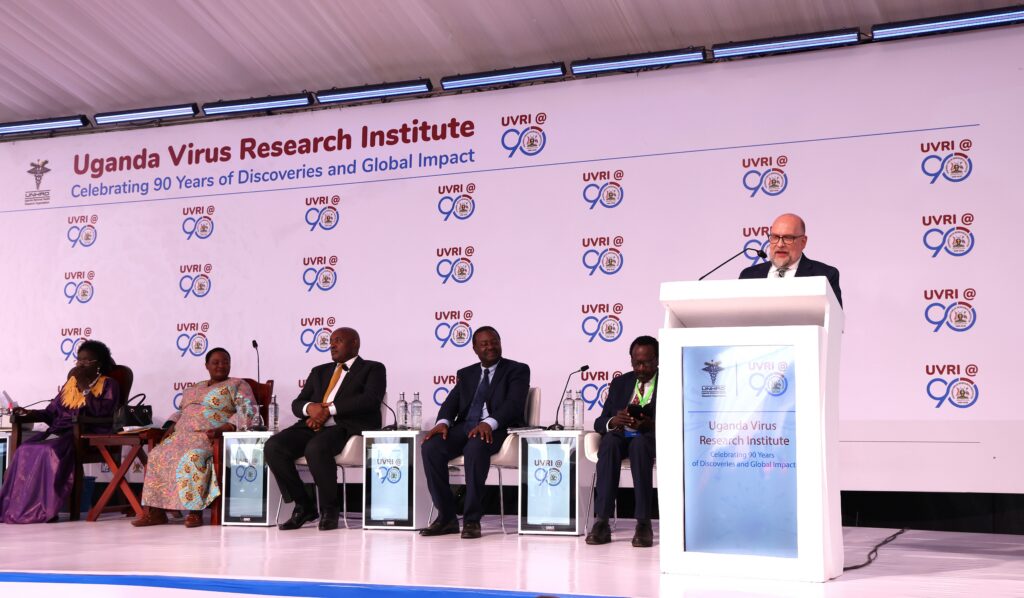
Remarks by Chargé d’Affaires Mika Cleverley at UVRI 90th Anniversary Celebrations
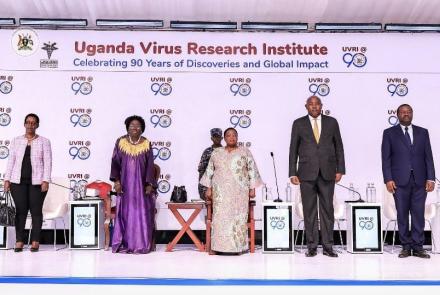
Good afternoon, Director General Kaleebu, Honorable Ministers, distinguished guests, members of the diplomatic corps, scientists and staff of UVRI, ladies and gentlemen.
It is my privilege to join you today in celebrating a truly remarkable milestone: the 90th anniversary of the Uganda Virus Research Institute.
Ninety years is not merely an anniversary. It is a testament to science in service of humanity. On behalf of the American people, congratulations to the Uganda Virus Research Institute, the Government of Uganda, and the generations of scientists, technicians, and staff whose work has made this institution a global leader in public health.
The story of UVRI is, in many ways, the story of American-Ugandan partnership itself. In 1936, when the American Rockefeller Foundation helped establish what was then the Yellow Fever Research Institute, few could have imagined the institution it would become. But the vision was clear even then: that scientific excellence, combined with local knowledge and international collaboration, could protect lives and advance human progress.
That vision has been realized beyond measure. From this campus in Entebbe, Ugandan and American scientists working side by side discovered West Nile virus and Zika virus—pathogens that would later emerge as global health threats. They pioneered research on Rift Valley Fever, developed vaccines, and built the scientific infrastructure that has made Uganda a leader in disease surveillance and outbreak response across Africa.
 For nearly a century, American institutions have partnered with UVRI to advance science and public health. By the 1990s, the U.S. Centers for Disease Control and Prevention and the U.S. National Institutes of Health had deepened that relationship, advancing HIV research, supporting the first HIV vaccine evaluation trial in Africa, and generating the pilot data that helped launch the U.S. President’s Emergency Plan for AIDS Relief—PEPFAR—worldwide.
Over the years, the United States has contributed nearly $100 million to support HIV programs, strengthen laboratory systems, expand surveillance, and improve Uganda’s health security. But numbers alone cannot capture the impact of this partnership.
That commitment has produced real results. CDC helped UVRI build a Biosafety Level 3 laboratory that reduced laboratory turnaround times for deadly viruses like Ebola and Marburg from over a month to under 48 hours. That facility now serves as a regional reference laboratory for East and Central Africa—a resource not just for Uganda, but for the entire region.
In October 2022, NIH opened state-of-the-art laboratory facilities on this campus, expanding capacity for basic virological research and pathogen surveillance at the animal-human interface. This investment recognizes a fundamental truth: emerging infectious diseases do not respect borders. Preventing the next pandemic requires vigilance, scientific excellence, and partnership.
U.S. foreign assistance reaches well beyond Entebbe. With support from CDC and the U.S. Defense Threat Reduction Agency, the UVRI Arua Field Station—at the crossroads of Uganda, the Democratic Republic of Congo, and South Sudan—has grown from a specialized plague laboratory into a regional testing platform for Ebola, monkeypox, cholera, yellow fever, and more.
During the current Ebola response, the Arua lab has tested more than 200 specimens across three sub-regions, putting diagnostics where they were needed most. Faster diagnostics. Faster response. Better protection for communities. This is what effective partnership looks like.
Today, I am pleased to mark this anniversary with concrete demonstrations of continued U.S. commitment to UVRI and to Uganda’s health security.
First, the U.S. Department of War is transferring a fully equipped mobile laboratory and two vehicles, valued at over $930,000, to strengthen outbreak detection and emergency response. This mobile laboratory will enhance UVRI’s ability to respond rapidly to disease outbreaks wherever they occur, bringing sophisticated diagnostic capabilities directly to affected communities.
Second, I am delighted to announce that UVRI has been awarded $245,000 through the U.S. Ambassador’s Fund for Cultural Preservation to complete the UVRI Museum. Ninety years of discoveries—from yellow fever to HIV to Ebola—deserve to be preserved and shared with future generations. This museum will not only honor the past but inspire the next generation of Ugandan scientists who will carry this mission forward.
As America celebrates its 250th anniversary in 2026, and UVRI celebrates 90 years of scientific excellence, this museum will stand as a permanent testament to what our two nations can achieve when united by shared values and common purpose.
As you know, last December, the United States and Uganda signed a five-year, $2.3 billion health cooperation Memorandum of Understanding to save lives and build a resilient and durable health system Uganda can sustain for itself. This agreement reflects a fundamental principle of American foreign assistance: we seek not dependence, but partnership. Not temporary solutions, but enduring institutions.
 The East African Community Centre of Excellence being launched today reflects exactly what effective U.S. foreign assistance aims to achieve: capable, self-reliant institutions that protect their own people and strengthen regional stability. UVRI is not just a Ugandan institution—it is a regional asset and a global partner in the fight against infectious diseases.
To the scientists, technicians, and field staff of UVRI: your work has saved lives too numerous to count. You have trained a generation of scientists who carry this mission forward. You have responded to outbreaks when others fled. You have advanced human knowledge in ways that benefit not just Uganda, not just Africa, but all humanity.
Your dedication embodies the best of what science can achieve when guided by a commitment to the common good. On behalf of the American people, thank you, and congratulations.
Ninety years ago, American and Ugandan visionaries came together to establish an institution dedicated to understanding and combating infectious diseases. Today, that institution stands as one of Africa’s premier research centers and a model of international scientific collaboration.
As we celebrate this milestone, we also look forward. The challenges ahead—emerging infectious diseases, antimicrobial resistance, climate change and health—will require the same spirit of partnership, the same commitment to scientific excellence, and the same dedication to serving humanity that has defined UVRI for 90 years.
The United States is proud to stand with UVRI, with Uganda, and with all who believe that science, partnership, and perseverance can build a healthier, more secure world for all.
Congratulations on 90 remarkable years. Here’s to the next 90.
Thank you.