
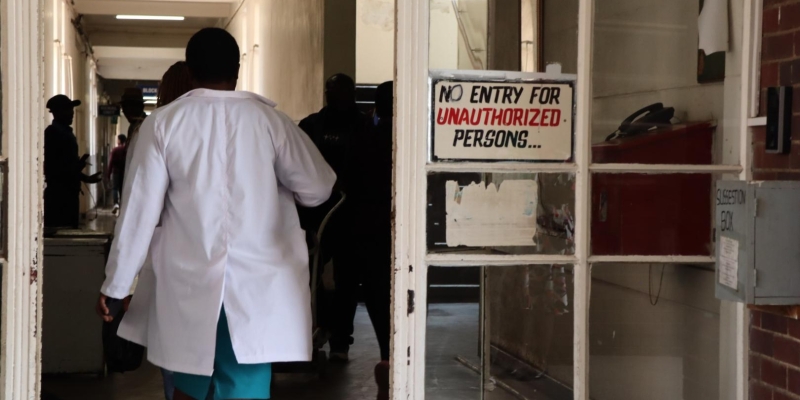
Zimbabwe has reached a significant milestone in sustaining strong disease surveillance systems following the successful Integrated Polio and Measles Accreditation Review of the National Virology Laboratory, conducted according to WHO standards. This achievement highlights the country’s leadership in supporting regional and global health priorities, particularly in polio eradication and measles and rubella elimination.
WHO periodically accredits laboratories supporting vaccine-preventable disease surveillance to ensure that global elimination and eradication goals are backed by reliable, high-quality laboratory results. These laboratories must consistently generate accurate and timely data. The accreditation visit, conducted with support from the WHO Regional Office for Africa, recognized the Zimbabwe National Laboratory’s growing role in supporting regional and global efforts to detect and respond to polio, measles, rubella, and other vaccine-preventable diseases in an integrated manner. This underscores the country’s contribution to the broader global polio eradication and measles and rubella elimination agenda.

Zimbabwe’s laboratory surveillance for polio and measles dates back to the early 1990s and 2000s, respectively, when case-based surveillance systems were established at the National Virology Laboratory. Poliovirus surveillance initially focused on processing stool specimens from Acute Flaccid Paralysis (AFP) cases, the gold standard for poliovirus detection, while measles and rubella surveillance relied on serological testing to identify recent infections. These systems formed the backbone of Zimbabwe’s laboratory-based disease surveillance, ensuring rapid detection and investigation of suspected cases.
Over the years, the Government of Zimbabwe, with technical support from WHO and global partners such as Rotary International, CDC, The Gates Foundation, and others, has strengthened the laboratory as a critical node within the regional polio and measles laboratory networks.
A major advancement came in 2024 with the establishment of Environmental Surveillance (ES) within the National Virology Laboratory to complement AFP surveillance for poliovirus. Supported by WHO and The Gates Foundation, ES allows wastewater testing for poliovirus, providing a sensitive tool to detect virus circulation even in the absence of clinical cases. By May 2025, the laboratory was authorized by WHO to independently process environmental surveillance samples, expanding Zimbabwe’s poliovirus surveillance capabilities. This achievement was made possible through collaborative technical support from regional and international partners, including the National Institute for Communicable Diseases (South Africa) and the Uganda Virus Research Institute. Zimbabwe now joins a network of 16 polio laboratories equipped to process both AFP and environmental samples, enhancing the sensitivity and timeliness of virus detection.

Between 26 January and 6 February 2026, WHO conducted an integrated accreditation review for polio, measles, and rubella. The laboratory achieved full accreditation for polio (virus isolation, intratypic differentiation, and environmental surveillance) and for measles/rubella serological confirmatory testing. This was the result of meeting or exceeding WHO performance indicators, including external quality assurance for testing accuracy. Zimbabwe’s long-established measles and rubella surveillance system, based on confirmatory testing of suspected cases with fever and maculopapular rash, continues to provide critical data, supporting immunization program monitoring and documenting progress toward maintaining a polio-free status and advancing measles/rubella elimination goals.
As highlighted by the WHO Representative in Zimbabwe, Dr Tiruneh Desta: “Building diagnostic capacity builds resilience. This achievement reflects WHO’s commitment to enabling countries to detect, decide, act faster and contain transmission of polio while connecting the national laboratory to a trusted global laboratory network that strengthens regional and global health security.”
The 2026 WHO accreditation visit aligns with the Global Polio Surveillance Action Plan (GPSAP) 2025–2026, which integrated reviews for polio, measles, and rubella into a single cost-effective accreditation process. This approach reflects the evolving global surveillance strategy, leveraging shared laboratory platforms to detect and control multiple priority diseases simultaneously.
The laboratory’s performance highlights the strong leadership of national authorities, in collaboration with WHO country, regional, and intercountry teams, and partners such as NICD and UVRI. These partnerships have been instrumental in building technical capacity, maintaining high-quality standards, and strengthening laboratory resilience.
As Zimbabwe continues to enhance its surveillance network, this accreditation underscores the country’s commitment to protecting its population from vaccine-preventable diseases and contributing to the global goal of a polio-free world. The expanded laboratory capacity strengthens national preparedness and reinforces the resilience of the regional surveillance system.
As Rooyen Mavenyengwa, Director of the National Virology Laboratory in Zimbabwe, noted: “Zimbabwe appreciates the long‑standing collaboration with WHO and partners and is proud to join the global network of laboratories that collectively strengthen regional and global health security, while continuing to strengthen national diagnostic capacity for the health and well‑being of its people.”
This accreditation marks another important step in Zimbabwe’s sustained commitment to resilient health systems and to advancing global disease elimination and eradication efforts.